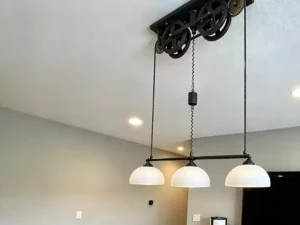
Two-story foyers create a grand entrance in modern homes and luxury villas. However, a 20-foot ceiling also creates a serious maintenance problem. Dust collects on crystal pendants every few months, and light bulbs eventually burn out.
Homeowners usually face two bad options. You can climb a shaky 16-foot A-frame ladder, or you can pay a professional crew $500 to set up indoor scaffolding.
A motorized foyer light lift solves this problem permanently. You press a button on a remote control, and the electric winch lowers your chandelier to eye level in minutes.
Before you buy a chandelier lowering kit, you must match the motor specifications to your ceiling structure. This guide explains how to calculate your required weight capacity, cable length, and mounting space for a 20-foot ceiling.
Step 1: Calculate Your Chandelier Weight (Plus the 25% Safety Rule)
Every light lift for chandelier applications has a strict maximum load limit. Selecting a motor that barely matches your fixture weight strains the internal gears.
Electrical contractors follow a simple rule: add a 25% safety margin to your chandelier’s actual weight.
- Check the manufacturer’s box or spec sheet: Find the “Gross Weight” or “Installed Weight” of your chandelier.
- Include glass and crystal: Many lighting brands list the frame weight separately from the crystal ornaments. You must add both numbers together.
- Add the 25% buffer: If your crystal chandelier weighs 80 lbs (36 kg), you should multiply 80 by 1.25. Your minimum target capacity is 100 lbs (45 kg).
Quick Weight-to-Model Matching Table
AMZHO manufactures motorized lifts for every residential and commercial size. Use this table to match your fixture weight to the right winch model:
| Chandelier Fixture Type | Typical Fixture Weight | Recommended AMZHO Model | Max Load Capacity | Motor Power |
| Small Foyer Pendant / Lantern | 20 – 85 lbs (10 – 38 kg) | XJ50 | 110 lbs (50 kg) | 120W |
| Medium Two-Story Crystal Light | 85 – 175 lbs (38 – 80 kg) | XJ100 | 220 lbs (100 kg) | 200W |
| Large Villa / Grand Entryway Fixture | 175 – 260 lbs (80 – 120 kg) | XJ150 | 330 lbs (150 kg) | 213W |
| Oversized Custom Statement Light | 260 – 440 lbs (120 – 200 kg) | XJ250 | 550 lbs (250 kg) | 430W |
Note: If your project involves a massive hotel lobby or church fixture over 500 lbs, view our complete commercial and residential motorized chandelier lift system specifications up to 2,200 lbs (1000 kg).
Step 2: Measure Your Lifting Height for a 20-Foot Ceiling
Many buyers confuse ceiling height with lifting drop distance. You do not need to lower the chandelier all the way to the hardwood floor. In fact, touching the floor can damage delicate crystal drops at the bottom of the fixture.
You only need to lower the fixture until the center sits at chest level—roughly 3 to 4 feet (1 to 1.2 meters) above the floor.
The Math for a 20-Foot Foyer:
- Total Ceiling Height: 20 feet (6.1 meters)
- Comfortable Working Height off the Floor: 4 feet (1.2 meters)
- Required Cable Travel Distance: 16 feet (4.9 meters)
Standard AMZHO chandelier winches include 23 feet (7 meters) of high-tensile steel wire rope. This standard length handles any 20-foot to 25-foot residential foyer with plenty of spare cable. If your home has a 30-foot vaulted ceiling, our factory also builds custom cable lengths upon request.

Step 3: Check Your Ceiling Space (Attic Mount vs. Recessed Mount)
A chandelier lowering kit needs a secure anchor point above your ceiling drywall. Before you order, you or your electrician should inspect the space directly above the foyer.
Option A: Above-Ceiling Attic Mount (Most Popular for Homes)
If you have an accessible attic above your two-story foyer, installation takes very little effort. Your installer bolts the steel mounting bracket directly across the wooden ceiling joists or steel trusses in the attic. Only a small canopy plate shows on the living room ceiling, keeping the winch motor completely out of sight.

Option B: Recessed Ceiling Mount (For Flat Concrete or Closed Ceilings)
Some modern villas have a second-floor bedroom directly above the foyer, or they use solid concrete ceiling slabs. In this case, you cannot access an attic. Installers mount the compact winch inside a recessed ceiling cavity and cover it with a decorative trim plate.
Step 4: Verify Voltage and Safety Features
Never hang a heavy overhead fixture on a cheap garage hoist. A garage utility winch lacks electrical disconnect plates and ceiling locks. A true light lift for chandelier maintenance includes specific architectural safety mechanisms:
- Automatic Power Disconnect: The winch cuts electrical power to the chandelier before the motor starts descending. You can wipe down bulbs with a damp cloth at ground level with zero risk of electric shock.
- Non-Steel Wire Load-Bearing Structure: Once the chandelier reaches the ceiling, a mechanical lock grabs the fixture. The steel cable does not hold the weight during daily use. This design prevents cable stretching over time.
- Pure Copper Motor & Brake: If a power outage happens while you lower the light, an internal self-locking brake stops the drum immediately.
- 110V / 220V Compatibility: North American homes run on standard 110V–120V AC power, while European and Asian homes use 220V–240V. AMZHO supplies both 110V and 220V configurations to match your local electrical code.
Ready to Upgrade Your Foyer Maintenance?
Stop risking your safety on tall ladders. Whether you are building a new custom home or retrofitting an existing entryway, the right foyer light lift turns a two-hour chore into a two-minute job.
Explore our full range of CE-certified motorized chandelier lift systems and chandelier lowering kits to view real load-test videos, compare models from 50kg to 1000kg, or request a custom recommendation for your ceiling structure.