You already have a chandelier you love. Maybe it has been hanging in your foyer for years, or perhaps it is a large crystal fixture above a staircase that would be difficult and expensive to replace.

There is just one problem: cleaning it, changing bulbs, or adjusting its height is not easy.
At some point, you may start wondering whether you can add a pulley system to the chandelier so it can be lowered when needed and raised back into position afterward.
The good news is that converting an existing chandelier may be possible in some situations. However, it is not always as simple as attaching a pulley, adding a rope, and balancing the fixture with a counterweight.
The chandelier’s construction, total weight, ceiling support, electrical connections, and the way the lifting mechanism will be secured all matter.
There are also several ways to approach the project, ranging from a visible decorative pulley arrangement to a purpose-designed motorized chandelier lift.
Let’s look at what is involved and how to decide which option makes sense for your existing fixture.
Can You Convert an Existing Chandelier Into a Pulley System?
Yes, an existing chandelier may be adaptable to a pulley-operated or motorized lifting arrangement, but compatibility must be assessed before any modification.
A suitable design needs to support the chandelier’s full weight, accommodate its movement, maintain a safe electrical arrangement, and provide secure stopping and locking provisions.
Some fixtures may work with a specially designed manual or counterweight system. Others may require a motorized lifting solution or modifications to the existing suspension assembly.
In some cases, the ceiling structure or chandelier design may make conversion impractical.
The first thing to clarify is what you actually want the chandelier to do.
Do You Want to Lower It for Cleaning and Maintenance?
This is one of the most common reasons people consider a chandelier pulley system.
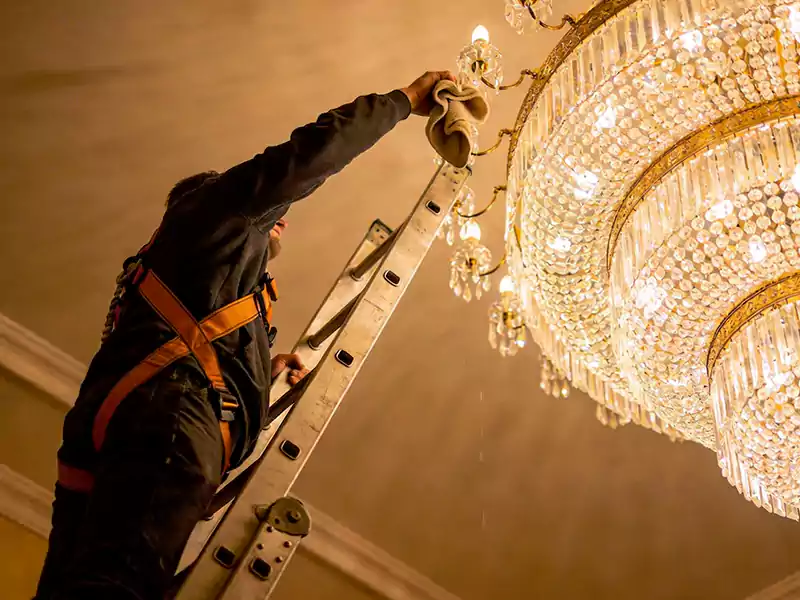
A chandelier hanging 15 or 20 feet above the floor can be difficult to reach. Even changing a light bulb or cleaning individual crystal pieces may require temporary access equipment and careful planning.
If you want to bring the fixture down for occasional maintenance and raise it back to its original position afterward, a dedicated chandelier lifting system may be worth considering.
Do You Want to Adjust Its Hanging Height?
Some homeowners want more flexibility over the height of an existing chandelier.
For example, a fixture may hang too low above a dining table, or a renovated room may have a different furniture arrangement.
This is slightly different from a maintenance lift.
A permanent height adjustment usually involves changing the suspension arrangement, while a pulley-operated system is intended to allow the fixture to move between positions.
Before making a decision, determine whether you need one-time height adjustment or repeated movement throughout the chandelier’s service life.
For more information about height adjustments and lifting options, see our guide on how to raise a chandelier safely.
Do You Want the Pulley System to Be Part of the Interior Design?
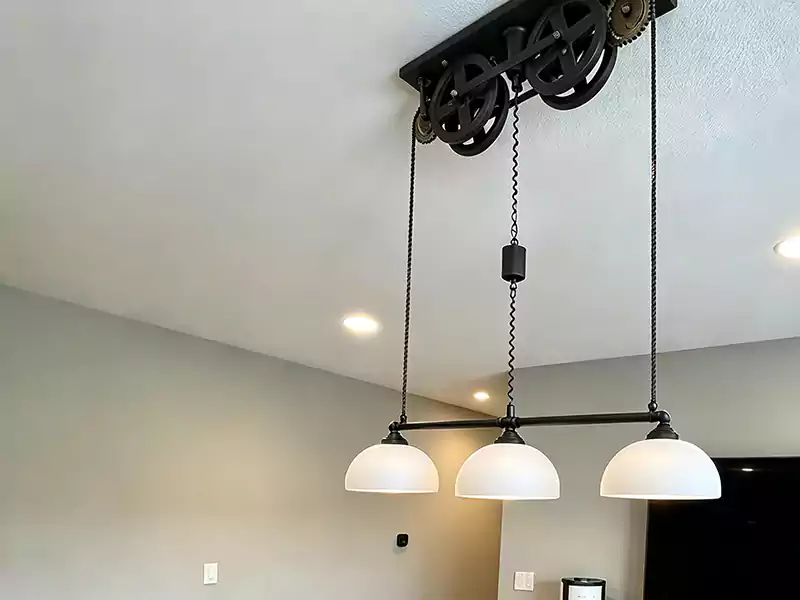
Some chandeliers are designed with exposed pulleys, ropes, and counterweights as visible decorative elements.
This can create an industrial, vintage, or workshop-inspired appearance.
A decorative pulley, however, is not necessarily a functional lifting mechanism. If you want the chandelier to move, the mechanical parts must be designed for the actual load and movement rather than simply added for appearance.
Three Ways to Convert or Adapt an Existing Chandelier
There is no universal conversion kit that works with every chandelier.
The right approach depends on the fixture, the building, the required movement, and how often you plan to operate the system.
Here are three approaches worth discussing with a lighting professional.
1. A Decorative Pulley and Counterweight System
A traditional pulley chandelier can use visible wheels, suspension cables, and a counterweight to create a movable lighting arrangement.
The counterweight helps balance the chandelier during movement, while the pulleys guide the suspension line along its intended path.
Unlike a conventional fixed chandelier, the fixture is designed to move between different positions.
This type of arrangement can be attractive in rooms with industrial, vintage, or mechanical interior designs.
However, adapting an existing chandelier can be more complicated than designing a new one around a pulley system.
A useful example is Moonshine Lamp Co.’s custom moving pulley chandelier project.
The company describes how it redesigned an existing chandelier concept to accommodate a moving pulley arrangement. Reducing the fixture’s weight was part of the design process because the additional counterweight increased the demands on the installation.
That example illustrates an important point: a functional pulley chandelier is often an engineered lighting design, not an ordinary chandelier with an extra rope attached.
Best suited for: Custom lighting projects where visible mechanical components are part of the desired appearance.
2. A Manual Rise-and-Fall Chandelier System
Another possibility is a manual rise-and-fall mechanism.
Instead of relying on an electric motor, the system uses a hand-operated lifting arrangement to change the fixture’s position.
Depending on the design, it may incorporate pulleys, suspension cables, counterweights, or a dedicated manual operating mechanism.
The advantage is that powered lifting is not required.
However, manual operation does not automatically make a system simpler or safer. The complete arrangement still needs an appropriate load rating, suitable ceiling support, secure holding provisions, and an electrical connection designed for the fixture’s movement.
A decorative cord or ordinary pulley hardware should not be treated as a rated chandelier lifting system.
It is also important to distinguish a manual height-adjustable pendant from a system intended to lower a heavy chandelier for maintenance. They may look similar, but their operating requirements can be very different.
Best suited for: Compatible fixtures where manual height adjustment is the main requirement and a properly engineered system is available.
3. A Motorized Chandelier Lift
For homeowners and building managers who want convenient, repeatable lifting, a motorized chandelier lift is another option.
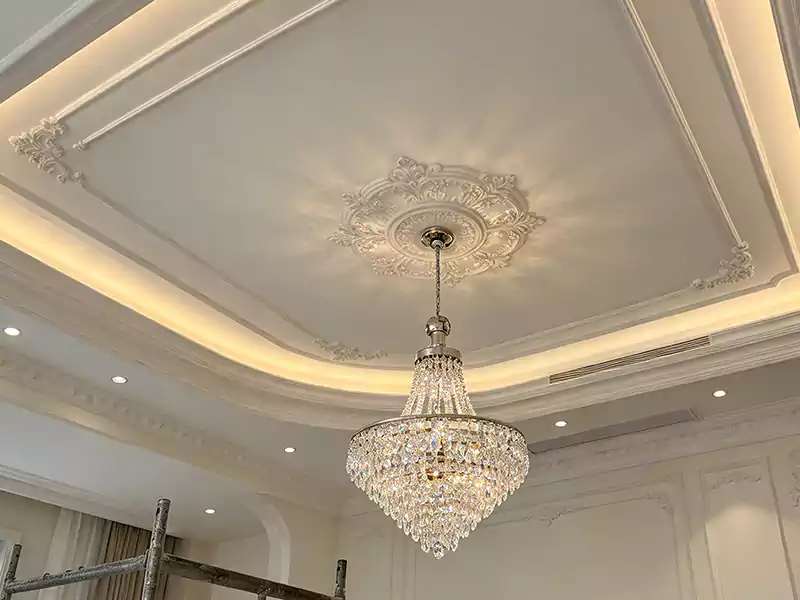
Rather than relying on someone to pull a rope or manually operate a counterweight, the lifting system uses an electric motor and a purpose-designed mechanical arrangement.
A typical system may include:
- An electric motor and lifting mechanism.
- A steel-wire lifting cable.
- Ceiling mounting and support components.
- A remote controller or another supported operating interface.
- Model-specific braking, mechanical locking, and electrical safety components.
When operated according to the manufacturer’s instructions, a suitable motorized chandelier lift can lower the fixture to a more accessible working position and raise it back to its installed location.
This makes it worth considering when cleaning, bulb replacement, and inspection are recurring tasks.
The important distinction is that a motorized chandelier lift is not automatically compatible with every existing chandelier.
The fixture’s weight, suspension points, mounting arrangement, ceiling structure, electrical connection, and required lifting travel must all be evaluated before selecting a system.
You can explore AMZHO’s motorized chandelier lift systems to review available product configurations and discuss a project-specific application.
What Should You Check Before Converting Your Chandelier?
Before investing in a pulley arrangement or motorized lift, take time to understand the existing installation.
A chandelier may look straightforward from below, but several important details are hidden above the ceiling.
1. The Actual Weight of Your Chandelier
Start with the fixture’s total installed weight.
Do not estimate based on its appearance alone. A large crystal chandelier, for example, may contain a substantial metal frame, multiple glass components, decorative fittings, and suspension hardware.
Where available, check the manufacturer’s product specifications or installation documents.
If a counterweight system is being considered, the additional weight of the counterweight and associated hardware must also be included in the overall structural assessment.
The complete system needs to be evaluated, not just the chandelier by itself.
2. The Existing Ceiling Structure
This is one of the most important parts of a conversion assessment.
An ordinary decorative ceiling canopy or electrical box should not automatically be assumed suitable for supporting a moving chandelier.

The mounting arrangement may need to connect to properly assessed ceiling framing, structural beams, or another engineered support system.
The assessment should consider the fixture, lifting mechanism, counterweight if applicable, mounting brackets, and forces associated with movement.
Drywall or decorative ceiling panels alone should not be treated as structural support.
A qualified professional should determine whether the existing ceiling arrangement is suitable or whether additional structural work is required.
3. The Chandelier’s Suspension and Attachment Points
Look at how the chandelier is currently supported.
Does it hang from a central chain, a rigid downrod, multiple suspension points, or a specially designed frame?
A lifting system needs compatible attachment points and a controlled movement path.
A chandelier designed only for fixed suspension may require a revised mounting or support arrangement before it can be moved.
The fixture should also remain stable during movement rather than tilting, rotating unexpectedly, or putting stress on decorative components.
4. The Electrical Connection
This part deserves particular attention.
An ordinary chandelier installation is generally designed around a fixed electrical connection. Once the fixture starts moving, the wiring arrangement must also be suitable for that movement.
The electrical connection needs to accommodate the intended travel without creating excessive strain, twisting, pinching, or damage to the insulation.
Some purpose-designed systems use specific electrical transfer or contact arrangements. Others may require a different manufacturer-approved solution.
Do not assume that simply leaving extra electrical wire inside the ceiling will make an existing chandelier suitable for a pulley system.
Electrical modifications should be assessed and carried out by a qualified electrician in accordance with the applicable installation requirements.
5. Locking and Stopping Mechanisms
A chandelier should not rely on someone holding a rope or manually maintaining tension as its only means of support.
A functional lifting arrangement needs suitable provisions for controlling movement and securing the fixture in its intended positions.
Depending on the design, these may include mechanical locks, brakes, stops, and other retention components.
The exact arrangement must come from the equipment manufacturer’s design and installation specifications.
6. Available Space Above the Ceiling
The lifting mechanism needs somewhere to be installed.
An attic, ceiling cavity, service space, or other accessible area may provide installation opportunities, but the available space varies considerably between buildings.
Measure the available installation area and consider the required lifting travel, cable routing, and access for future inspection.
A system that fits comfortably above an open attic ceiling may not be suitable for a shallow ceiling cavity.
This is why it is better to assess the building before selecting the equipment.
Why Simply Adding a Pulley to an Existing Chandelier May Not Work
A pulley can change the direction of an applied force, and a counterweight can help balance a moving load. But those basic mechanical principles do not make every existing lighting fixture suitable for conversion.
There are several reasons why an improvised modification may fail to meet the requirements of a real installation.
The ceiling may not be designed for the additional load.
A counterweight and lifting assembly can add substantial weight to the structure. Mounting locations and load paths need to be assessed.
The chandelier may not be designed for movement.
Decorative arms, crystal fittings, connection points, and the main frame may need to be reviewed before introducing movement.
The existing electrical connection may not be suitable.
A fixed hanging fixture and a moving chandelier have different electrical requirements.
The system may not have appropriate locking provisions.
A pulley that can move a fixture is not necessarily a system that can securely hold it in the required position.
For these reasons, it is better to treat a chandelier conversion as a lighting and structural engineering project rather than a weekend DIY modification.
For general background on chandelier mounting and wiring, see Lowe’s chandelier installation guidance. For a specific example of a purpose-designed counterweight chandelier, Holly Hunt provides Counterweight Chandelier Installation Instructions, which specify installation by a qualified electrician.
These documents illustrate why the mounting structure and electrical work need to be considered as part of the complete installation.
Manual Pulley vs. Motorized Chandelier Lift: Which Should You Choose?
If your existing chandelier can be adapted, the next question is how you want to operate it.
The following comparison gives you a starting point.
| Factor | Manual Pulley / Counterweight | Motorized Chandelier Lift |
| Operating method | Hand-operated mechanism | Electric motor and supported controls |
| Visual appearance | Can be exposed as a decorative feature | Often designed for a concealed ceiling installation |
| Power for movement | Does not rely on an electric lifting motor | Requires a suitable electrical supply |
| Height adjustment | Depends on the manual mechanism | Depends on the model’s specified lifting travel |
| Maintenance convenience | Depends on the design and operating effort | Powered operation can reduce manual lifting effort |
| Installation requirements | Engineered pulleys, counterweight, support, and locking provisions | Motor, lifting assembly, structural mounting, controls, and electrical arrangements |
| Best use | Custom manual or decorative moving-chandelier applications | Repeated lowering and raising for maintenance |
Neither option is automatically suitable for every chandelier.
The actual load capacity, mechanical design, installation requirements, and electrical arrangements matter more than whether a system is described as manual or motorized.
For a closer look at the engineering and operating differences, read our guide to motorized chandelier hoist vs. manual chandelier pulley system.
Can an Existing Chandelier Be Used With an AMZHO Motorized Lift?
Possibly, but the existing fixture must be assessed before compatibility can be confirmed.
AMZHO manufactures motorized chandelier lifting equipment for residential and commercial high-ceiling applications.
The aim is to provide a controlled way to lower compatible light fixtures for maintenance and return them to their designated ceiling position.
When evaluating an existing chandelier, the important information includes:
- The chandelier’s total installed weight.
- Its dimensions and suspension arrangement.
- The ceiling height and desired lifting travel.
- The ceiling’s supporting structure.
- Available installation space above the ceiling.
- The existing electrical arrangement.
- The preferred control method.
If a fixture uses a non-standard suspension arrangement or has unusual installation requirements, a customized configuration may need to be considered.
AMZHO can review the project information and discuss whether a suitable motorized lifting configuration is available.
Explore our chandelier lift product range or learn more about customized lighting lifting solutions.
What Information Should You Prepare Before Requesting a Conversion Assessment?
You do not need to understand every mechanical detail before speaking with a supplier or installer.
A few photographs and basic measurements can make the initial discussion much more useful.
| Information | Why It Matters |
| Chandelier photos from several angles | Helps identify the fixture’s design and suspension arrangement |
| Approximate fixture weight | Provides a starting point for load assessment |
| Ceiling height | Helps establish the required lifting travel |
| Ceiling structure | Helps identify potential mounting requirements |
| Photos of the ceiling area above the fixture | Helps assess available installation space, where accessible |
| Existing electrical details | Helps determine what further electrical assessment is needed |
| Intended use | Clarifies whether you need maintenance access or frequent height adjustment |
It is also useful to explain why you want the chandelier to move.
Are you trying to make regular cleaning easier? Do you want to change the height of the fixture from time to time? Or are you planning a renovation and want to keep the existing chandelier?
The answer can make a significant difference to the recommended solution.
Keep Your Existing Chandelier. Choose the Right Lifting Solution.
If you already own a chandelier that you love, replacing it is not necessarily the first option to consider.
A pulley or counterweight arrangement may work for certain custom lighting designs. A manual rise-and-fall system may suit some height-adjustment applications. For repeated maintenance in a high-ceiling space, a motorized chandelier lift may offer a more convenient approach.
What matters is finding a solution that works with the actual fixture and building rather than trying to adapt a general-purpose pulley to an installation that was never designed to move.
AMZHO manufactures motorized chandelier lift systems for residential, commercial, and high-ceiling projects.
If you are considering converting an existing chandelier, share its weight, dimensions, ceiling height, and installation photos with our team. We can review the available information and discuss a suitable lifting configuration.
Explore AMZHO chandelier lift systems or contact our team about your project.
If cleaning is the main reason you want to modify your existing chandelier, our guide to cleaning a chandelier on a high ceiling also explains the challenges of maintaining fixtures that are difficult to reach.